
The Nikon FE, a classic 35mm SLR, boasts a robust build and reliable performance, appealing to both enthusiasts and professionals.
This camera, frequently discussed within online Nikon communities, offers a blend of manual control and automated convenience.
User manuals and repair documentation are readily available online, including detailed guides for addressing common issues like aperture ring malfunctions.
Nikon FE users actively share troubleshooting tips and maintenance advice on platforms like Facebook and dedicated Nikon forums.
What is the Nikon FE?
The Nikon FE (released in 1982) is a mechanically controlled, aperture-priority automatic exposure SLR camera. It represents a pivotal point in Nikon’s history, bridging the gap between fully mechanical models and those with more electronic features.
Unlike its fully electronic counterpart, the FE2, the FE relies on a mechanical shutter, ensuring operation even without batteries – though metering and aperture-priority auto exposure require power.
Online resources, including freely available instruction manuals, detail its capabilities; The Nikon FE is celebrated for its durability and user-friendly design, making it a popular choice for film photography enthusiasts.
Communities like the “Nikon Club Ufficiale” demonstrate ongoing interest and support for this classic camera, with users sharing experiences and troubleshooting advice.
Its built-in flash readiness indicator, visible in the viewfinder, is a particularly appreciated feature.
Key Features and Specifications
The Nikon FE operates on a focal plane shutter, offering speeds from 2 seconds to 1/1000th of a second, plus Bulb mode. It accepts Nikon F-mount lenses, providing a vast selection of compatible optics. The camera utilizes a 5-segment Center-Weighted metering system, offering reliable exposure readings in various lighting conditions.
Key specifications include compatibility with TTL flash systems, as highlighted in manuals intended for Canon and Nikon DSLRs utilizing similar flash control. It requires a 4LR44 or equivalent 6V battery for metering and electronic functions.
The viewfinder provides approximately 93% coverage.
Online documentation, including PDF manuals and service guides, details lens compatibility and specifications.
Users frequently discuss its robust construction and reliable performance within online Nikon communities, emphasizing its enduring appeal.
Understanding the Camera Body
The Nikon FE’s body, detailed in user guides, features a durable construction and intuitive layout. Online resources showcase front and rear views, aiding component identification.
Front and Rear Views Explained
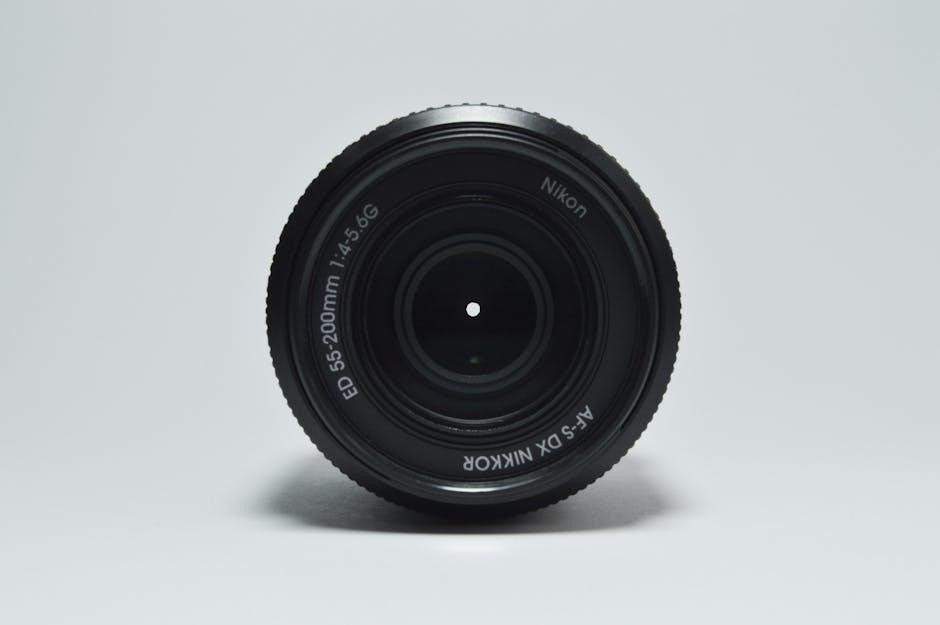
Examining the Nikon FE’s front, you’ll find the lens mount, crucial for attaching various Nikkor lenses. The self-timer release and depth-of-field preview lever are also prominently positioned. Online resources, often shared within Nikon enthusiast communities, provide labeled diagrams illustrating these components.
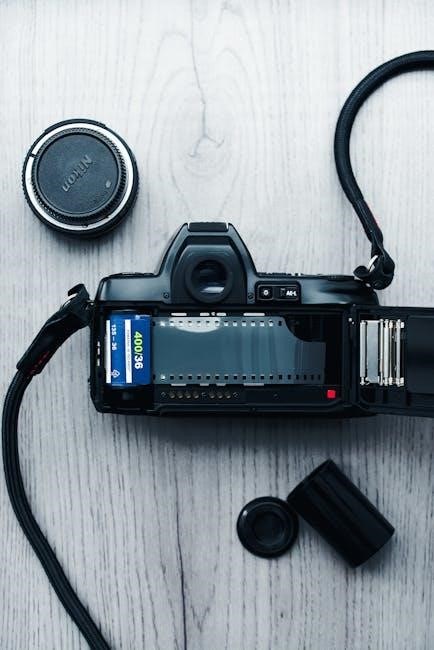
Turning to the rear, the viewfinder eyepiece allows for clear composition. The film rewind crank and film advance lever control film loading and progression. The camera’s back door provides access to the film chamber. User manuals detail the proper procedure for loading and unloading film. The hot shoe, for attaching external flashes, is located on top.
Detailed guides available online, including those shared on Facebook repair logs, highlight the location of the battery compartment and the various dials and switches that control the camera’s functions. Understanding these elements is key to mastering the Nikon FE.
Controls and Dials: A Detailed Overview
The Nikon FE features several key controls. The shutter speed dial, located on the top plate, allows selection from 2 to 1/2000th of a second, influencing motion blur and exposure. Adjacent is the aperture control ring on the lens, working in tandem with the shutter speed.
Exposure compensation is managed via a lever, adjusting the meter’s reading for challenging lighting. The film speed dial sets the ISO, crucial for accurate metering. Online communities frequently discuss optimal settings for various film types.
The mode selector switches between aperture-priority auto and manual modes. The self-timer allows for delayed shutter release. User manuals and repair logs, like those found on Facebook, detail the function of each dial and lever. Mastering these controls unlocks the FE’s full potential.
Using the Nikon FE: Basic Operation
Successfully operating the Nikon FE requires understanding film loading, battery installation, and fundamental settings. Online resources detail these steps, ensuring proper camera function and image capture.
Loading Film and Battery Installation
Loading film into the Nikon FE is a straightforward process. First, open the camera back using the film release lever. Insert the 35mm film cassette into the film chamber, ensuring it seats correctly. Thread the film leader onto the take-up spool, advancing it a couple of turns with the film advance lever. Close the camera back securely.
Battery installation is equally simple. The Nikon FE utilizes a standard button cell battery (typically an LR44 or similar). Locate the battery compartment, usually on the underside of the camera. Open the compartment and insert the battery, observing the correct polarity (+/-). Ensure the battery is firmly seated before closing the compartment. A functioning battery powers the light meter, essential for accurate exposure.
Always double-check that the film is properly loaded and the battery is correctly installed before attempting to take photographs. Refer to the full user manual for detailed diagrams and instructions.
Setting Aperture and Shutter Speed
The Nikon FE offers full manual control over aperture and shutter speed, crucial for creative photography. The aperture ring, located on the lens, controls the lens opening, influencing depth of field and light intake. Adjust it to the desired f-stop (e.g., f/2.8 for shallow depth of field, f/16 for large depth of field).
The shutter speed dial, situated on the camera body, determines the duration the shutter remains open, affecting motion blur and overall exposure. Select the appropriate shutter speed (e.g., 1/125s for freezing action, 1/30s for slight motion blur).
Utilize the built-in light meter to assist in achieving correct exposure. Observe the meter readings in the viewfinder and adjust aperture and shutter speed accordingly. Remember the interplay between these settings – a wider aperture requires a faster shutter speed, and vice versa, to maintain proper exposure.
Focusing Techniques with the Nikon FE
Achieving sharp focus with the Nikon FE relies on manual focusing, demanding practice and precision. Look through the viewfinder and rotate the focusing ring on the lens until your subject appears crisp and clear. Utilize the split-image rangefinder in the center of the viewfinder – align the split image for accurate focus.
For stationary subjects, take your time and carefully refine the focus. With moving subjects, pre-focus on a point where the action will occur and track the subject as it moves, adjusting the focus ring smoothly.
Be mindful of depth of field; a smaller aperture (larger f-number) increases depth of field, keeping more of the scene in focus. If experiencing focusing issues, ensure the lens is securely mounted and consider potential adjustments as discussed in online repair communities.
Advanced Features and Techniques
Mastering the Nikon FE involves exploring exposure compensation, metering modes, and flash photography. Online resources detail utilizing the built-in light meter for precise exposures.
Exposure Compensation and Metering Modes
The Nikon FE offers versatile metering modes to suit various shooting scenarios. Understanding these is crucial for achieving correctly exposed images. The camera primarily features center-weighted metering, prioritizing the central portion of the frame for light evaluation. However, users can employ exposure compensation – a vital tool when the camera’s meter is fooled by particularly bright or dark subjects.
Exposure compensation is adjusted via a dial surrounding the shutter speed control, allowing for plus or minus adjustments to the metered exposure. This is particularly useful in backlit situations or when photographing subjects with high contrast. Online communities emphasize practicing with exposure compensation to develop an intuitive understanding of its effects. Mastering these features, as detailed in user manuals and forum discussions, unlocks the FE’s full potential for creative control.
Using the Built-in Light Meter
The Nikon FE’s built-in light meter is a cornerstone of its functionality, assisting photographers in achieving accurate exposures. Accessed through the viewfinder, the meter displays a needle indicating underexposure, correct exposure, or overexposure. To activate the meter, half-press the shutter release button. The needle will move, responding to the light levels detected by the camera.

Interpreting the meter reading is straightforward: aim to align the needle with the ‘0’ mark for a properly exposed image. Remember the FE utilizes center-weighted metering, so composition impacts the reading. Online resources and user manuals highlight the importance of understanding how different scenes affect the meter. Regularly checking the meter and utilizing exposure compensation, when needed, ensures consistently well-exposed photographs, a key skill emphasized by Nikon enthusiasts.
Flash Photography with the Nikon FE
The Nikon FE seamlessly integrates with flash units, offering versatile lighting options. A key feature is the built-in flash readiness indicator within the viewfinder, allowing photographers to confirm the flash is charged without diverting their gaze. Compatibility extends to TTL flash systems, commonly used with Canon and Nikon digital SLRs, though adapters may be necessary for modern units.
User manuals emphasize the importance of understanding flash synchronization speed – typically 1/250th of a second on the FE. Exceeding this speed can result in partially obscured images. Online Nikon communities frequently discuss flash troubleshooting, particularly issues with units failing to fire. Proper flash usage, combined with the FE’s metering system, unlocks creative potential for portraits, fill-flash, and low-light photography.
Troubleshooting Common Issues
Nikon FE users often encounter aperture control ring problems and flash malfunctions, documented extensively online. Focusing issues also arise, requiring careful adjustment and potential repair services.
Aperture Control Ring Problems
A frequently reported issue with the Nikon FE, as detailed in online repair logs and forum discussions, concerns the aperture control ring. Users describe a stiff or unresponsive ring, preventing accurate aperture selection. This often stems from dried-out lubricant within the aperture mechanism.
Disassembly, documented in Facebook repair series, reveals the intricate components requiring cleaning and re-lubrication. The repair process involves carefully removing the top cover and accessing the aperture linkage. Specialized lubricants are recommended to ensure smooth operation without damaging the delicate parts.
Online communities emphasize the importance of patience and precision during this repair. Incorrect reassembly can lead to further complications. If uncomfortable with disassembly, seeking professional service is advised. Several Nikon repair specialists offer services for this specific issue.
Flash Not Firing: Diagnosis and Solutions
A common concern for Nikon FE users is a non-firing flash. Initial checks should verify battery levels in both the camera and the flash unit itself. The Nikon FE features a built-in indicator in the viewfinder to confirm flash readiness, a crucial diagnostic tool.
If the indicator doesn’t illuminate, examine the flash shoe contacts for corrosion or debris. Cleaning these contacts with a soft cloth can restore the connection. Ensure the flash unit is securely mounted and the camera is set to a mode allowing flash operation.
Online forums highlight potential issues with the camera’s internal flash circuitry, though these require professional repair. Users report success with simple contact cleaning and battery replacement. If problems persist, consulting a Nikon service center is recommended for a thorough diagnosis.
Focusing Issues and Adjustments
Nikon FE focusing relies on manual operation, demanding practice and a keen eye. Users sometimes report difficulties, particularly with older lenses. Initial troubleshooting involves verifying the lens is securely mounted and the focusing ring moves smoothly.
Check for play or looseness in the lens mount, as this can introduce inaccuracies. Online communities discuss subtle adjustments possible with some lenses, but caution against attempting repairs without expertise. A common issue, noted in repair documentation, is stiff focusing rings due to old lubricant.
Proper technique is key: utilize the split-image rangefinder in the viewfinder for precise focusing. If consistent issues persist, professional calibration of the lens or camera may be necessary. Remember, a slight misalignment can significantly impact image sharpness.
Maintenance and Care
Regular cleaning with a soft cloth preserves the Nikon FE’s functionality. Proper storage, away from dust and moisture, ensures longevity, as advised by Nikon enthusiasts online.
Cleaning the Camera Body and Lens
Maintaining your Nikon FE’s pristine condition requires gentle cleaning practices. Begin by using a soft, dry microfiber cloth to wipe down the camera body, removing dust and fingerprints. For stubborn grime, slightly dampen the cloth with distilled water – avoid harsh chemicals or solvents.
Lens cleaning demands extra care. Utilize a blower brush to dislodge loose particles before employing lens cleaning tissue and a dedicated lens cleaning solution. Apply the solution to the tissue, not directly onto the lens, and wipe in a circular motion.
Pay attention to the viewfinder and film chamber. Gently dust these areas to prevent scratches. Regular cleaning, as discussed within Nikon user communities, safeguards the camera’s performance and extends its lifespan. Avoid excessive moisture, especially around electrical contacts.
Proper Storage and Handling
Protecting your Nikon FE from damage begins with mindful handling and appropriate storage. When not in use, store the camera in a cool, dry place, ideally within a dedicated camera bag or case. Avoid extreme temperatures and humidity, which can affect the internal mechanisms.
Always hold the camera securely, using both hands to prevent accidental drops. Be cautious when changing lenses or film, ensuring a firm grip. Avoid exposing the camera to direct sunlight for extended periods, as this can degrade the materials.
Regularly check the battery compartment for corrosion and keep it clean. As discussed in Nikon enthusiast forums, proper storage and careful handling are crucial for preserving the FE’s functionality and value over time, ensuring years of reliable service.