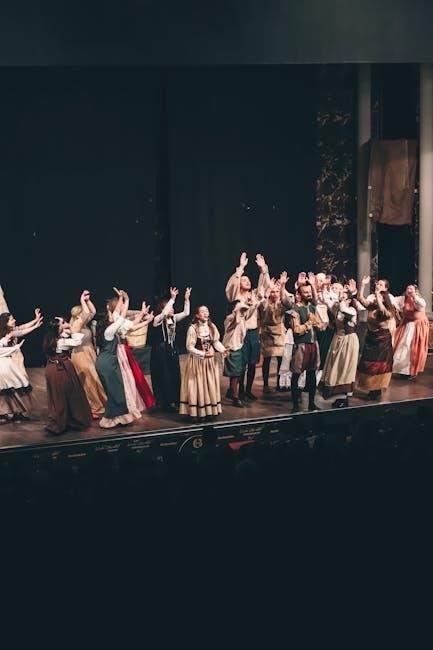
Understanding Short Scenes for Young Actors (PDF)
Short scenes are vital for young actors’ growth, offering focused practice and character exploration within manageable lengths, often available as convenient PDF downloads.
What are Short Scenes for Young Actors?
Short scenes for young performers are excerpts from plays, typically ranging in length to suit focused study and performance practice. These scenes, often found in PDF format, provide concentrated opportunities for actors to develop their craft without the extensive commitment of a full-length production.
They are specifically chosen to be age-appropriate, featuring relatable themes and language. These scenes allow young actors to delve into character development, explore a variety of emotional range, and practice working collaboratively with two to four actors. Compilations of these scenes offer a full spectrum of experiences, aiding in memorization and fostering a personal connection to the material.
The Importance of Scene Study for Development
Scene study, particularly with short scenes available as PDF resources, is crucial for young actors’ development. It allows them to move beyond simply reciting lines and encourages deeper character exploration. These focused exercises build essential skills like analyzing context and developing believable character backstory.
Working with scenes fosters collaboration, listening skills, and responsiveness – vital for any actor. The manageable length of short scenes allows for repeated practice and refinement, building confidence and technique. Furthermore, exposure to a range of age-appropriate material expands their emotional range and prepares them for diverse roles and auditions.
Where to Find PDF Resources
PDF scene resources are readily available through online databases, dedicated acting websites, and educational theatre organizations, offering convenient access for young performers.
Online Databases and Websites
Numerous websites compile and offer short acting scripts in PDF format, specifically catering to middle school and teenage actors. These platforms frequently provide school-appropriate scenes sourced from published plays, available for free use and download.
Actors can directly access these resources by clicking on provided title links to download the Scene PDF. These online databases are invaluable for quickly locating suitable material. Many sites also categorize scenes by the number of actors – often focusing on selections for two to four actors – simplifying the search process.
Regularly updated collections ensure a fresh supply of options, making these websites a cornerstone for educators and aspiring performers seeking accessible scene study materials.
Dedicated Acting Resource Sites
Specialized acting resource sites curate collections of monologues and scenes, including those formatted as PDFs, designed for auditions and classroom use. These sites often feature materials extracted from plays, television shows, and films, providing a diverse range of options for young actors.
Resources like Acting Audition Resources offer continually updated lists of free materials. These dedicated platforms frequently categorize content by age range and skill level, streamlining the selection process. They are particularly useful for finding effective monologues for kids and teens alongside suitable short scenes.
These sites represent a focused approach to providing quality audition and training materials.
Educational Theatre Organizations
Educational theatre organizations frequently offer PDF compilations of short scenes specifically tailored for young actors. These organizations recognize the need for age-appropriate material that supports skill development and provides audition pieces.
Many organizations publish scene books containing thirty-four scenes, designed to explore a full spectrum of emotions and relationships. These collections prioritize manageable lengths, aiding memorization and allowing actors to forge a personal connection with their characters.
These resources are often created by theatre educators, ensuring relevance and suitability for classroom and performance settings, providing valuable short scenes for middle school actors;

Content and Characteristics of Suitable Scenes
Suitable scenes prioritize age-appropriate themes, character development, and a variety of emotional range, typically designed for two to four actors.
Age-Appropriate Themes and Language
Selecting scenes with age-appropriate themes is paramount when working with young actors. Content should resonate with their experiences and understanding, avoiding mature or complex issues they may not be equipped to handle emotionally or interpret accurately.
Language within the scenes must also be carefully considered. Avoid slang, profanity, or overly sophisticated vocabulary that could hinder comprehension or create discomfort. The goal is to provide material that allows actors to focus on character work and performance, not struggle with the text itself.
Scenes should explore relatable situations – friendships, family dynamics, school life – presented in a way that is both engaging and respectful of their developmental stage. Prioritizing positive and constructive themes fosters a safe and productive learning environment.
Focus on Character Development
Short scenes uniquely allow young actors to deeply explore character development without the extensive commitment of a full-length play. This concentrated format encourages focused analysis of motivations, relationships, and emotional journeys.
Actors can delve into a character’s backstory, objectives, and internal conflicts within a manageable timeframe, fostering a stronger personal connection to the role. This intensive work builds crucial skills in observation, empathy, and imaginative thinking.
The brevity of the scenes also allows for repeated rehearsals and experimentation, enabling actors to refine their choices and discover nuanced layers within the character. It’s a powerful tool for building confidence and technique.
Variety of Emotional Range
Short scene collections for young actors, often found as PDF resources, intentionally provide a full spectrum of emotions to explore. This is crucial for developing versatility and expanding an actor’s emotional toolkit.
These scenes present opportunities to portray joy, sadness, anger, fear, and everything in between, allowing actors to safely practice accessing and expressing a wide range of feelings. This builds emotional intelligence and strengthens their ability to connect authentically with a character’s inner life.
Exposure to diverse emotional landscapes prepares young performers for the demands of various roles and auditions, fostering confidence and artistic growth.
Scenes for Two to Four Actors
Many short scene compilations, readily available as PDF downloads, specifically cater to smaller ensembles – typically two to four actors. This format is ideal for classroom use, workshops, and early performance experiences.
These scenes offer manageable challenges, allowing each actor significant stage time and opportunities for interaction. They encourage collaboration and the development of dynamic relationships within a limited timeframe.
Resources often include school-appropriate scenes designed for middle-school and teenage actors, providing a practical and accessible starting point for scene study and performance practice. Finding scenes designed for these numbers simplifies casting and rehearsal logistics.

Utilizing PDF Scene Books
PDF scene books offer a curated collection, enabling exploration of diverse emotions and characters, while facilitating comfortable memorization and personal connection for young actors.
Benefits of Compiled Scene Collections
Compiled scene collections, often found as PDF downloads, provide a significant advantage for young actors. They eliminate the time-consuming process of individually sourcing appropriate material. These collections frequently feature a wide range of scenes, allowing actors to explore various genres, character types, and emotional landscapes.
Furthermore, these books are designed with the needs of developing performers in mind, offering age-appropriate content and manageable scene lengths. This curated approach fosters a focused learning environment, enabling actors to delve deeper into character development and refine their acting techniques without the overwhelming commitment of a full-length play. The convenience and variety make them invaluable resources.
Exploring a Full Spectrum of Emotions
Short scenes, readily available as PDF resources, are excellent tools for young actors to safely explore a diverse range of emotions. Collections specifically designed for this age group offer material covering everything from joy and excitement to sadness, anger, and fear – all within age-appropriate contexts.
This focused exploration allows actors to practice accessing and portraying these emotions authentically, building their emotional range and control. The shorter format reduces the pressure, enabling experimentation and risk-taking. These scenes provide opportunities to understand how emotions manifest in different characters and relationships, fostering a deeper connection to the work and enhancing their overall performance skills.
Memorization and Personal Connection
PDF scene books for young actors often feature shorter works, intentionally designed for comfortable memorization. This allows the focus to shift from rote learning to deeply understanding the character and their motivations. Once lines are secure, actors can truly inhabit the role, exploring nuances and making authentic choices.
Developing a personal connection to the scene is crucial. Actors are encouraged to find relatable aspects within the character’s experiences, drawing on their own emotional understanding. This process transforms the scene from words on a page into a living, breathing moment, enriching the performance and fostering genuine emotional resonance.

Formats and Accessibility
eBook formats like ePub, PDF, MOBI, and AZW provide easy access to short scenes for young actors, enabling convenient downloading and printing.
Common eBook Formats (ePub, PDF, MOBI, AZW)
Young actors accessing short scenes will encounter various eBook formats. PDF is universally readable, preserving formatting, ideal for printing. ePub reflows text for different screen sizes, excellent for tablets and e-readers. MOBI, commonly used by Kindle devices, offers a streamlined reading experience. AZW is another Kindle format, often with enhanced features.
Choosing a format depends on the device and preference. PDF ensures consistent presentation, while ePub and MOBI prioritize readability on digital devices. These formats make finding and utilizing scene work incredibly accessible, supporting the development of aspiring performers through readily available resources.
Downloading and Printing PDF Scenes
Downloading PDF scenes for young actors is typically straightforward; links on websites or databases lead to direct downloads. Ensure the source is reputable to avoid malware. Once downloaded, open the PDF with Adobe Acrobat Reader or a similar program – often pre-installed on computers.
Printing scenes is simple: select “Print” from the file menu. Consider printing only the necessary pages to conserve paper. Many scenes are designed for easy readability when printed. Having a physical copy aids memorization and annotation, allowing actors to mark notes and blocking directly on the script, enhancing their preparation.
Effective Scene Selection Criteria
Selecting scenes should match an actor’s skill level, considering length and complexity, and aligning with potential audition requirements for optimal success.
Matching Scenes to Actor Skill Level
Careful scene selection is paramount, directly correlating with a young actor’s current abilities. Beginners benefit from simpler scenes with straightforward emotional arcs, allowing them to focus on foundational techniques like objective work and basic characterization.
More experienced actors can tackle scenes with greater nuance, complex relationships, and challenging emotional demands. Avoid overwhelming less experienced performers with material beyond their grasp; this can hinder growth and diminish confidence.
Consider the actor’s strengths – are they naturally comedic or dramatic? Choose scenes that showcase their talents while also providing opportunities for stretch and development. A well-matched scene fosters a positive learning experience and builds a strong foundation for future roles.
Considering Scene Length and Complexity
Scene length is a crucial factor when working with young actors; shorter scenes, typically found in PDF collections, are ideal for memorization and in-depth work. Complexity should align with experience – avoid overly verbose dialogue or intricate plot points for beginners.
Focus on scenes with clear objectives and relatable conflicts. A scene that’s too long can be daunting, hindering an actor’s ability to fully embody the character. Similarly, excessive complexity can obscure the core emotional truth.
Prioritize scenes that allow for focused exploration of character and relationship, providing a manageable challenge that fosters growth and builds confidence.
Relevance to Audition Requirements
When selecting scenes – often found as PDF downloads – consider potential audition needs. Many auditions request specific scene styles or length constraints. Having a repertoire of appropriately sized and themed scenes is invaluable.
Look for scenes showcasing versatility; a range of emotions and character types demonstrates an actor’s breadth. Ensure the scene aligns with the age range typically sought for auditions.
Prioritize scenes that allow the actor to shine, highlighting their strengths and minimizing reliance on a partner. Familiarity with published plays, available through resources, can be advantageous.

Resources for Monologues Alongside Scenes
Acting audition resources provide both monologues and scenes, often as PDFs, offering young actors comprehensive material for practice and performance preparation.
Acting Audition Resources: Monologues & Scenes
Numerous online resources compile monologues and scenes specifically for young performers, frequently offered as downloadable PDF documents. These collections draw from published plays, television scripts, and films, providing a diverse range of material.
These resources are invaluable for audition preparation, allowing actors to practice both individual character work (through monologues) and interactive performance (with scenes). Updated frequently, these sites often categorize material by age range, gender, and emotional tone, simplifying the selection process.
Accessing these free resources empowers young actors to build their repertoire and hone their skills, offering a convenient and cost-effective way to prepare for auditions and performance opportunities.

Effective Monologues for Kids/Teens
Finding effective monologues for younger actors is crucial for showcasing their talent, and many are available alongside short scene collections in PDF format. These selections often focus on relatable experiences and age-appropriate emotions, allowing teens to connect authentically with the material.
Resources like those offering “3-2-1-” style monologues provide concise pieces ideal for building confidence and demonstrating range. The best monologues reveal character and tell a story within a limited timeframe, perfect for auditions or classroom work.
Prioritizing pieces that resonate with the actor’s personality ensures a more compelling and genuine performance, maximizing their impact and potential.
Tips for Working with Short Scenes
Flexibility is key when working with short scenes; expect changes and embrace adaptation, fostering creativity and deeper understanding of the material.
Five Expect Things To Change Be Flexible
Adaptability is paramount when utilizing short scenes for young actors. Directors and even the actors themselves may discover new nuances during rehearsals, necessitating adjustments to interpretation.
Encourage a mindset where unexpected shifts are viewed as opportunities for growth, not setbacks. This fosters a collaborative environment where experimentation is welcomed.
Memorization, while important, shouldn’t become rigid; allow for organic delivery. Understanding the scene’s core intention is more valuable than flawlessly reciting lines.
Be prepared to revisit character choices and relationships as the scene evolves, embracing the dynamic nature of performance. This builds resilience and problem-solving skills.
Analyzing the Scene’s Context
Contextual analysis is crucial when working with short scenes. Before diving into performance, young actors should thoroughly investigate the scene’s setting, time period, and preceding events.
Understanding the “who, what, where, when, and why” establishes a solid foundation for informed character choices. Discuss the relationships between characters – are they friends, rivals, or strangers?
Explore the scene’s overall objective: what are the characters trying to achieve? Identifying the underlying motivations adds depth and authenticity to the performance.
Consider the playwright’s intent and the scene’s place within the larger narrative, even if it’s a standalone excerpt.
Developing Character Backstory
Character backstory is essential, even for short scenes. Young actors should create a rich history for their characters, extending beyond the script’s provided details.
Consider their upbringing, relationships, dreams, and fears. What significant events have shaped their personality? This internal life informs their present actions and reactions.
Backstory doesn’t need to be explicitly stated; it serves as a foundation for authentic choices. Explore how past experiences influence their objectives within the scene.
Developing a detailed backstory allows actors to embody the character fully, adding nuance and believability to their performance, even within limited screen time.